Using prior election narratives as predictions of the current election season should make you roll your eyes. They are fun ideas to play with, comparing Bernie Sanders to Dean and McGovern, but not very informative. Even comparing 2007 Clinton to 2015 Clinton is greatly misleading, so don’t mistake the following data for that. I do think that it is useful to look back at this time in the last, open presidential primary as a measure of the overall presidential campaign season. It is also valuable to remember how different the environment was as a reminder to avoid such juxtapositions.
So, take a ride with me back to 2007, when George W. Bush was president, and Barack Obama had a babyface. The economy had yet to fall to pieces, and no one outside Alaska had yet ever heard of Sarah Palin. Gay marriage was opposed by most major Democratic candidates and only legal in Massachusetts. It was way, way back when we were 4 years into a war in Iraq and Afghanistan…
National Polls
Barack Obama announced his candidacy for president on February 10, 3 months earlier in the calendar than Bernie Sanders would do. I was there on that freezing, seriously fucking freezing day that Obama announced his run. Obama had faced speculation about a run since his kick-ass DNC speech in 2004, so his name recognition was pretty high going in. It’s interesting to see that he hovered around the low 20%’s for so long into the campaign. He entered the 30%’s after winning the Iowa Caucus, but didn’t catch up to Hillary until Super Tuesday, halfway through the actual voting.
2008 National Polls, RCP
With Sanders’ late announcement and the wide gulf in name recognition, the current national polling is to be expected, no matter what the eventual fate of the Bernie Sanders campaign will be. Though he is ~10 points behind where Obama was at this time, Sanders has actually made greater gains since announcing than Obama did. There’s a lot of time left until people actually vote; It’s still very early.
2015 National Polls, RCP
Iowa Polls
At this time in 2007, Obama had been consistently in 3rd place behind Edwards and Clinton, though they were all close enough for it to be anyone’s game. The first debate was April 26, but the polls in Iowa didn’t really start to move until the fall and winter. It’s surprising to me how many debates passed before the field evolved toward what would be a decisive win for Obama and a disappointing 3rd place for Clinton: 38% Obama, 30% Edwards, 29% Clinton
2008 Iowa Polls, RCP
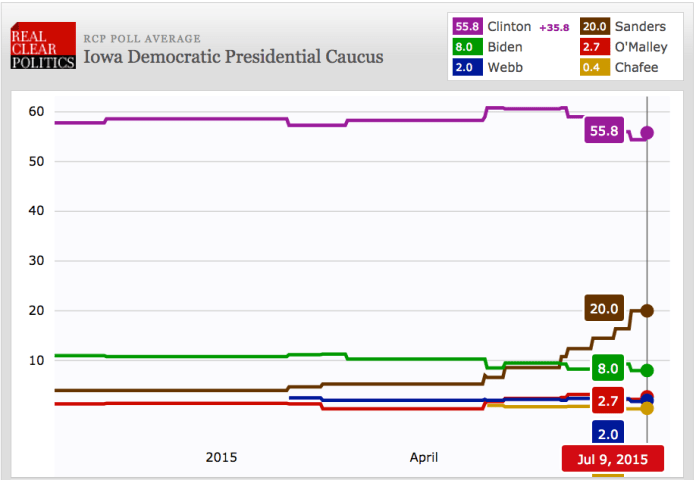
Considering that Bernie’s name recognition was nil going in, and with only one front-runner in competition, there was no place to go but up for him. What is compelling in all of these 2016 polls is that Biden and O’Malley have not made any gains. This is a legit, pro-Sanders momentum that is showing a true 2-person race. However, it is worth repeating this with every analysis of the 2016 polls: It’s way too early to be sure.
2015 Iowa Polls, RCP
New Hampshire Polls
New Hampshire was by far the most interesting story in the 2008 primary campaign. The polls proved to be wildly inaccurate, as an Obama lead and even momentum out of Iowa turned into a loss to Clinton in the Granite State, foreshadowing a long slog of a primary. Edwards support began draining to the two frontrunners, and his hope for a resurgence in South Carolina would not come.
As for the polls, at this point in the year, Edwards was slowly losing support, and wouldn’t really recover. During the fall, Obama’s support was actually falling in NH, despite gains in Iowa. A late surge in NH had many convinced he was in for a big win. Of course, we were reminded that we have to let people vote, and that New Hampshire voters don’t give a fuck about what anyone outside the state thinks.
Though New Hampshire revitalized Clinton’s campaign, New Hampshire polls are the ones that most have Bernie’s supporters doing happy dances. Bernie has gained 15 points in a couple weeks, which is corresponding to a drop in Clinton’s support. It’s easy to imagine Bernie even passing her in this state before the first debate. But again, it’s too early to tell.
2015 New Hampshire Polls, RCP
So What?
FiveThirtyEight did a great piece on Iowa and New Hampshire’s demographics misleading us in their affinity for Bernie Sanders. Read it. It emphasizes the need for Sanders to campaign and show progress beyond the early states, so take these results with that in mind. Unfortunately, there is hardly any polling in the Carolinas, where I really want to see how Sanders performs. I believe that once Sanders is in the debates and gets to tell stories of his role in the Civil Rights movement, his support will broaden a great deal. We also need to hear more of his personal narrative for him to be for real. If anything is clear it is that we’ve only just gotten started. Despite the compelling story of the Sanders Surge of Berniementum, the GOP primary is still the circus to watch. I mean, fucking Trump can be called one of the frontrunners. I’m popping the popcorn already.
“Josh: We’re not going to nominate another liberal, academic, former governor from New England. We’re dumb, but we’re not that dumb.
Leo: Nah, I think we’re exactly that dumb.”
Since this blog post is basically liberal porn, I thought that I’d start with one of the classics from Aaron Sorkin. What follows is simply a list of reasons that you can be optimistic about the Bernie Sanders campaign. I am, for the moment, ignoring the reasons to be pessimistic, and make no mistake, they are not trivial. However, the suggestion that Bernie has no chance or is an “issue” candidate is bullshit, and I’m all about dispelling bullshit.
1. Virtually any Democrat can defeat virtually any Republican in the Electoral College (The Blue Wall)
Take it away LOD:
Simply put, This isn’t the 1980’s, and I’ll be coming back to that a lot. Virtually any legitimate Democrat can defeat virtually any Republican in a general election for president with little effort, so if there was ever an opportunity for a true liberal reformer to win, this would be it. Don’t be scared Democrats. You don’t have to nominate a cynical, bible-thumping southern democrat to prove to the country that you’re not communists. Today’s United States is a country where conservatives have to prove that they’re not bigots, and so far, they are failing miserably.
2. Americans like change, and Bernie Sanders is not Barrack Obama
In the modern history of US presidential elections, Americans have had a tendency to vote for change. Presidents tend to see big losses for their party in midterm elections. More precisely, if we look at presidential elections following the retirement of a multi-term incumbent president, as we are now, we see a strong trend toward a change in party. The only exception was George HW Bush’s election following Reagan:
Excel spreadsheets! Data!
I find a similar quest for change when I look at nominees of the Democratic Party since FDR. I see an oscillation between southern and northern democrats when I account for the influence of incumbency. This bodes well for Bernie, because he embodies the successful narrative of a liberal challenge to Hillary Clinton, while having little in common with Obama personally.
The frustrations that democrats have had with the president are Bernie’s strengths: Steadfast, liberal principles, experience, and a belief in legislative leadership from the White House. Barack Obama is a young transformational figure who gives soaring speeches. His interviews are full of folksy but poetic rhetoric. His legislative agenda consists of good-faith, consensus building while leading from behind. In contrast, Bernie Sanders is an old white guy, terse and direct with a concrete legislative history and agenda. He doesn’t need to “evolve” in his beliefs to catch up with liberal Americans. For liberal democrats, even staunch Obama supporters, he can be seen as a breath of fresh air.
Bernie was not a member of the Obama administration, nor has he even been an official member of the Democratic party! He can distance himself from the president without difficulty, but in ways that don’t offend President Obama’s supporters. That is a significant superpower for a candidate.
3. Bernie will likely be the only legitimate Clinton alternative
Hillary Clinton has long been a divisive figure with high unfavorable ratings. At this time in 2007, she was seen as the clear front-runner for the nomination with a collection of “also ran’s” clipping at her heels. The fact that she lost in such a similar scenario simply shows that there is a significant part of the Democratic party that is interested in an alternative to her. During that campaign, it was young voters that turned out for Obama, and it’s eight years later. The young Obama supporters are 8 year older, with 8 years of voters that are younger still. The elderly Hillary supporters are older too. It’s difficult for me to imagine that the 2015 democratic landscape is any easier for her than in 2007. It also doesn’t seem plausible to me that her experience as Secretary of State does much to change that calculus. It wasn’t like she lost the nomination to Barack Obama because she wasn’t experienced enough.
One of the reasons that Romney won the last GOP primary is because there were so many non-Romney candidates that split the vote. Romney only won a majority of primary voters in 3 of the first 31 states. Speaking of splitting the vote, we often forget how many voters populist John Edwards took in the early 2008 primaries, averaging 17% before he withdrew, and yet the inevitable Hillary was still defeated by a divided left.
The way Bernie Sanders threads this needle is by being the only viable alternative to Hillary Clinton. Once the Elizabeth Warren people, favoring Warren’s honesty and reliability, believe her when she says that she is absolutely not running, Bernie is the obvious fall back. Bernie Sanders and Elizabeth Warren line up perfectly. If Bernie maintains viability, an endorsement from Elizabeth Warren could be all it takes to make this a close race.
Simply staying this course into the fall will improve Bernie Sanders’ favorables and name recognition. History shows us that campaign exposure only hurts Hillary Clinton. On the other hand, time will legitimize Sanders, the most important quality he needs to win the nomination, and we have a whole lot of time.
4. The thrilling GOP primary will motivate liberals and draw moderates away from Clinton
Holy shit the GOP nomination is going to be fun. Before this year, I couldn’t have imagined a campaign with all the entertainment of Republicans smacking each other around coupled with so much legitimate debate from serious candidates.
The GOP may have an incredibly difficult road in the general election, but their primary is riveting. Cable news might not have enough time in the day to cover it. The wall-to-wall coverage of these reactionary dipshits will motivate true liberals, which can only help Sanders. Conservative and moderate democrats will prefer to vote in the Republican primary, which will only hurt Clinton. To the extent that Sanders fails to prove a threat to Clinton in the polls, moderate democrats will be more and more interested in voting in the Republican primary so that their vote isn’t wasted on a Clinton coronation. On the other hand, Bernie’s voters won’t be going anywhere.
5. Americans don’t like dynasties, and Jeb Bush makes Clinton supporters even more uncomfortable
The better Jeb Bush does, the better Bernie Sanders will do. I think that the idea of a Hillary Clinton v. Jeb Bush election makes most Americans nauseated, even their respective supporters. I wouldn’t call Jeb Bush a front-runner, but he is a serious candidate with lots of money, so he won’t go away. A majority of Democrats may be willing to fall in line with Clinton if they have to, but the more they hear from Jeb Bush, the more they will be looking for a Clinton alternative to settle their stomach. Americans aren’t supposed to like royalty. I love it when Bernie says that Americans are tired of mainstream politics. It’s a great way to attack Clinton and emphasize the Clinton v. Bush dynasty without running a negative campaign.
6. Are Democrats really swayed by TV ads the way they used to?
The electorate, especially liberal democrats, is watching TV less and less. The internet is virtually free, and it’s ruled by secular liberals, Bernie’s people. Hillary Clinton wants to raise 2 Billion dollars… for what? The vast majority is spent on media, which young liberal democrats barely see. The rest is administrative costs and research. Sanders can get plenty of mileage out of free media until legitimacy and a good showing in Iowa and New Hampshire can catch him up.
7. Unions: The classic sugar daddy for Democrats is bound to love Bernie Sanders
Hillary is far and away the big money democrat in the race, but this, her greatest strength, is also her biggest weakness in my opinion. She literally embodies the wealth inequality that will be central to this election. However, I don’t think Bernie will be as poor as first thought.
The democratic “equivalent” of the corporate bankroll of republicans is labor unions, which have heavily funded Hillary Clinton and other democrats in the past. They don’t need more of a reason to do so than she is a democrat who can win. However, Bernie Sanders is an extreme union supporter, and the more he is considered a serious candidate, (he already is) the more he will draw money from union members. It’s in the best interests of union members to have his message be heard.
As debates about the TPP and TPA have raged, party lines have gotten awful confusing. However, there is one category of support that is anti-TPP across the board: unions. There is only one candidate who is passionately anti-TPP: Bernie Sanders. Sanders is going to get more money from labor than a lot of people think. The New England socialist bureaucrat can legitimately be the candidate of the working man.
8. Real data: Polls and campaign energy
Ignore all the national polls. We know that voters in Iowa and New Hampshire give zero fucks about them. Hillary Clinton has all the name recognition, and Bernie Sanders is the new kid on the block, so most of the polling rests on this difference. All an underdog candidate needs to establish legitimacy is a strong showing in Iowa and/or New Hampshire. (See Bill Clinton, John Kerry, and John McCain)
Despite the gulf in recognition, in only a few weeks of the young campaign, Bernie is pulling neck and neck with Hillary in New Hampshire. This is the New Hampshire where Clinton won in 2008. This isn’t merely due to Bernie’s increased name recognition in the northeast because his rise is very recent. Even if it was, is it so bad that the people who know him, like him? New Hampshire is hardly a liberal state.
Though lower than in NH, Bernie’s numbers are climbing steadily in Iowa and South Carolina as well, though polling is pretty old, and we’re just getting started. I predict that Sanders will lead Clinton in New Hampshire polls before the first debate. That’s when shit will get real. He has a good chance to win New Hampshire outright.
9. Throw away the 1980’s and 1990’s playbook. It’s not your mom’s Democratic party.
During the heart of the cold war, tumultuous domestic politics, and cultural revolution, conservatives have enjoyed great success since the mid 20th century. Nixon, Reagan, and the Bush’s creamed democrats in national politics. The democrats responded by shelving their northern liberalism for southern moderation. The strategy proved to be a good one for the time as Carter and Bill Clinton won close elections while Mondale, McGovern, Dukakis, and Kerry were thoroughly beat, hence the West Wing quote I started with.
Guess what? No one is afraid of communism anymore. Reagan Democrats are now enjoying the Social Security and Medicare they once tried to destroy. The religious right is waning and secular liberalism is growing fast. Marriage equality and Obamacare are now the law of the land and aren’t going anywhere. The Democratic Party and the country as a whole is significantly more liberal than even in 2008. You’ve heard it before, but it’s worth repeating: C’mon Democrats, grow a pair. It’s ok to be liberal. We are the liberal party, not the moderate Republican Party.
10. Bernie was Bernie before it was cool to be Bernie
Clinton can “evolve” toward the liberalism that today’s Democrats embrace, but she can’t erase history. She voted for the Iraq war and the Patriot act. She used to oppose marriage equality. She fought hard for NAFTA. She opposes single-payer health care. She’s taking huge, corporate, dirty money and playing the super PAC game.
The Clinton war room of the 90’s may have been able to spin their way out of a pickle jar, but Millennials aren’t that gullible. When she took those conservative positions, she didn’t do it in private. She’s on video. On the other hand, a younger Bernie Sanders can be seen furiously fighting a lost cause for what is now mainstream public opinion. Barack Obama probably won his primary almost entirely on his early opposition to the Iraq War, based on a speech he gave as a state senator. There wasn’t even video of that speech! Next to the shady, flip-flopping, conservative, cynical Clinton, we know who Bernie is because he did what was right before it was remotely popular. He is as forthright today as he ever was.
To quote more West Wing…
“I’m tired of it: year after year after year having to choose between the lesser of Who cares. Of trying to get myself excited about a candidate who can speak in complete sentences. Of setting the bar so low, I can hardly bear to look at it. They say a good man can’t get elected President. I don’t believe that. Do you?”
I have no idea how this shakes out. Is Bernie Sanders simply Howard Dean 2.0, bound for demise? I don’t know, but I think he’s smarter and more capable than Howard Dean. I think that the country is ready for a true liberal now more than anytime since FDR. I wish there were more true liberals running in the democratic primary rather than putting all our eggs into one basket, but then again, how appropriate for a democratic socialist?
In 1961, to mark the centennial of the Confederacy and oppose the Civil Rights Movement, the South Carolina Legislature passed a law requiring that the Confederate flag be flown atop the SC capitol building. In 2000, this was amended to move the flag to a flagpole in front of the capitol. The law states that a 2/3 majority vote of the legislature is required to change that statute, and includes the following stipulations:
“This flag must be flown on a flagpole located at a point on the south side of the Confederate Soldier Monument, centered on the monument, ten feet from the base of the monument at a height of thirty feet. The flagpole on which the flag is flown and the area adjacent to the monument and flagpole must be illuminated at night and an appropriate decorative iron fence must be erected around the flagpole”
“[The confederate flag] is square measuring fifty-two inches on each side”
“[Government officials] shall replace the flags at appropriate intervals as may be necessary due to wear.”
“The provisions of this section may only be amended or repealed upon passage of an act which has received a two-thirds vote on the third reading of the bill in each branch of the General Assembly.”
There is someconfusion as to whether a simple majority vote or 2/3 majority is required to repeal this law. However, even a majority of legislators has historically been tough to come given that a majority of South Carolina voters supporting the flying of the flag. Now that governor Nikki Haley has called for removing the flag, I would like to see her take immediate action.
Anytime you try to control speech or expression, either to prevent or require specific speech, you dive head first into absurdity. The law is full of loopholes, and our hands are anything but tied. Governor Nikki Haley has plenty of options. Here are a few of my proposals:
1. Add more flags
Ah, the power of dilution. There’s no doubt that the Confederate flag is a big part of the state’s heritage. So is the Union Jack, revolutionary war flags, and various other symbols. Perhaps there are some flags that represent abolitionism or civil rights that could be included, but I don’t know of any.
When Christians try to display religious symbols on public grounds, the common solution is to allow all religions to post displays. This inevitably leads to an absurd collection of displays, and finally, the appropriate exclusion of all religious displays. Perhaps there is a lesson here that we can apply to the confederate flag.
2. Tiny flag
The flag must be “fifty-two inches on each side, inclusive of the white border, with a St. Andrews Cross of blue…”. It is perfectly within the bounds of the law to simply make the border very, very wide.
3. Block the flag with something better
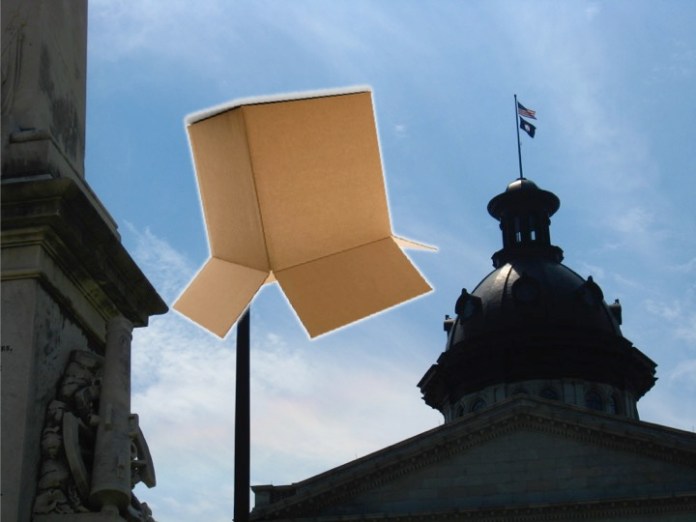
The law does not require that the flag be unobstructed, and there are a variety of creative ways to obstruct this symbol of destruction. I would recommend an elegant sculpture, perhaps made of a spiral of sheet metal that spirals around the flag pole. On the surface of this sculpture could be inked images of South Carolina’s history, great leaders, especially those who campaigned to abolish slavery and fight for civil rights. Let’s literally cover the flag with symbols of love, equality, and justice.
4. Improve access to the public rag
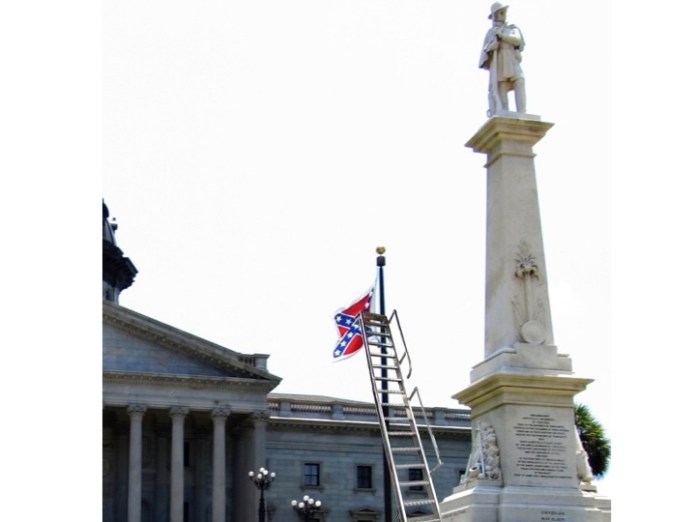
It has to be flown high on a flagpole, but no law can force us to respect it. The governor could assist us in taking out our frustration by building a safe ladder or set of stairs by which the public can approach the flag. It will make for a nice rag with which we can wipe our boots off.
5. Just take it down
Nikki Haley could simply ignore the law. Executives often take this authority as a retroactive veto. She could redirect or eliminate funding for maintaining the flag, and remove it for being too ratty. She could take advantage of the “reasonable” and “appropriate” language in the law to argue that the current climate of hate and racial prejudice makes the flying of the flag no longer sensible.
She could also simply defy the law. Pro-life legislators have certainly had no problem flagrantly defying Roe v. Wade. She might be impeached. So what? Even if she is impeached and convicted for doing the right thing, she will hardly be leaving office in disgrace. Doesn’t South Carolina honor its history of rebellion?
6. Desecrate it (fire, paint, bullets)
Sure, the flag has to fly there, but all we need the governor to do is loosen the security around the flag pole. I’m sure plenty of South Carolina’s citizens will dispose of it where it stands. They could even destroy the flag in a way that honors their southern pride. What could be more South Carolina than shredding it with assault weapons?
7. Make it artsy
While we are honoring southern history, let’s widen the display’s scope and make it look a little more artistic. For example, we could make the flagpole a lynching tree. We can honor the tradition of lynching black people while honoring those confederate soldiers who gave their lives to preserve the right to control and take the lives of others. The flag could even be hoisted by leather whips and hung from shackles. So many possibilities…
Tasteful? Of course not, but no less tasteful than the flag itself. The flag needs to be taken down. It is a symbol of treason, racism, and slavery. “Southern pride” is used as a code for racism as much as “modesty” is a euphemism for slut shaming. If you found anything I wrote here more offensive than the legally required, prominent flying of the confederate flag, displayed a stone’s throw from the body of State Senator Pinckney, his family and mourners, then fuck you.
I want to also point out that everyone arguing that the flag should be taken down because it is “offensive” is misguided. We don’t have the right to not to be offended. Lots of people are offended by guns, and many more are offended by Congress. The flag needs to be taken down because it is a symbol in clear contradiction of what the state is supposed to be providing its citizens. The government of South Carolina is subject to federal authority and is required to protect civil rights, two principles which the confederate flag explicitly contradict. It is a symbol of hate to the rest of the world, so familiar, that it is synonymous with the nazi swastika among neo-Nazis and white supremacists. Let’s not quibble about legislative procedure. Take that shit down.
Bernie Sanders has nutty hair. It has long been receding, but the wispy white hair he has left is even more unrestrained than his politics. It leaves one to wonder, how important is good hair to being elected president? I’m sitting in my lab with a depressing lack of promising biochemical data, so I figured I’d tackle this question first, while I wait to take my next timepoint. Therefore, I present my first original Reason Bound research: How important is good hair to being elected president of the United States?
Methods
I wanted to focus on only presidential candidates from the two major parties during the era of TV, so I went no further back than the election of 1960, the year of the first televised presidential debate. That gives us a sample size of 14 elections and 20 candidates. I calculated the ages of each candidate at the time of the election simply based on year of birth, so the age may be off by up to a year.
I subjectively rated candidates’ hair based on the first page of google images returned by “(Candidate’s name) + (year of election)”. I ignored pictures that were especially unflattering or satirical. The rating was made on a 5-point scale, “5” being the best, “1” being the worst. “3” is considered to be neutral, neither hurting nor harming a candidate. I tried to take popular hair styles of the time into consideration. For example, Jimmy Carter and Michael Dukakis have rather big, corny hair for modern times, but they were fashionable at the time. I remember an episode of SNL from 1976 that characterized Carter as having good hair. I also considered the relative quality of a candidates hair compared to their opponent. For example, Carter’s hair changed little from 1976 to 1980, but running against Ford make him look much better than running against Reagan. I did not consider general physical appearance, just hair in both quantity and quality.
Results
Year
Winner
Winner’s Age
Winner’s Hair
Loser
Loser’s Age
Loser’s Hair
2012
Obama
51
3
Romney
65
5
2008
Obama
47
3
McCain
72
1
2004
Bush
58
3
Kerry
61
5
2000
Bush
54
3
Gore
52
4
1996
Clinton
50
4
Dole
73
2
1992
Clinton
46
4
Bush
68
2
1988
Bush
64
3
Dukakis
55
5
1984
Reagan
73
5
Mondale
56
4
1980
Reagan
69
5
Carter
56
4
1976
Carter
52
5
Ford
63
2
1972
Nixon
59
3
McGovern
50
3
1968
Nixon
55
3
Humphrey
57
2
1964
LBJ
56
2
Goldwater
55
3
1960
Kennedy
43
5
Nixon
47
4
The first thing I noticed is that the losers had a much more diverse range of hair quality. Losers ranged from excellent to poor, while the winners tended to be more middle of the road. Winners and losers had a standard deviation of 1.01 and 1.33 respectively.
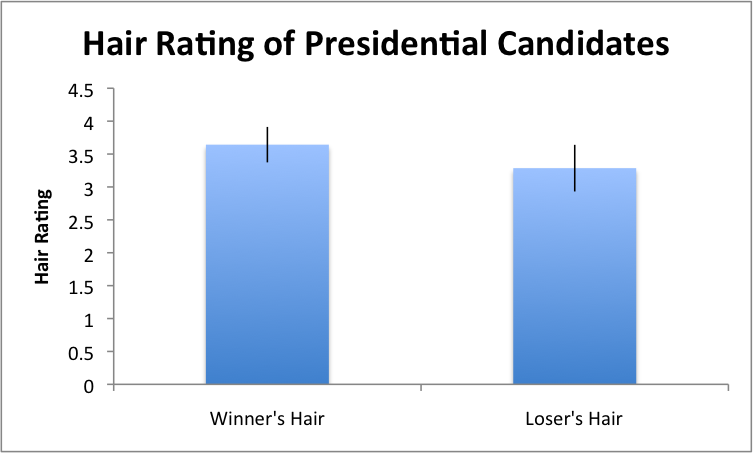
If we look simply at the average hair rating of winners v. losers, there appears to be the slightest of correlations in favor of good hair. Error bars reflect standard errors. This slight edge is maintained if I control for incumbency by removing incumbent presidents or men who had previously run for president.
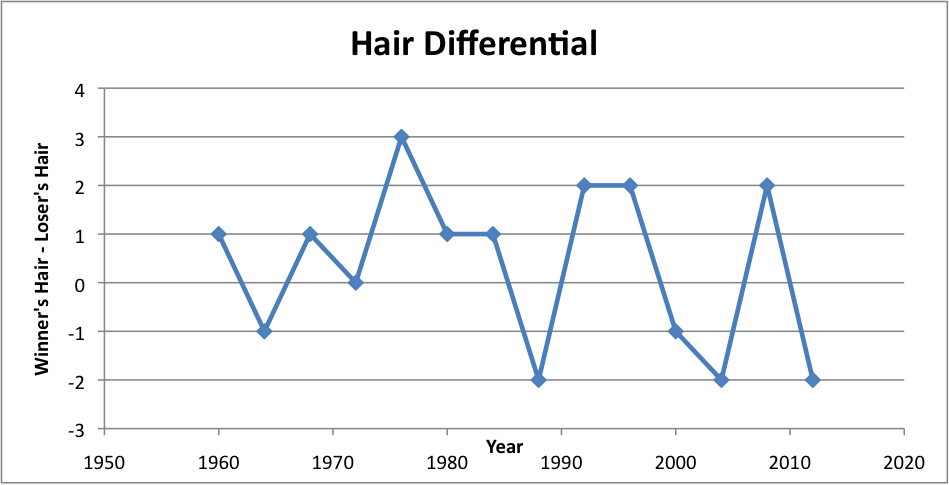
If we look at hair differential, we see a similar, though insignificant, edge to good hair. The guy with better hair won 8 times and lost 6 times. Whether or not the guy with better hair won also appears to be random. There doesn’t appear to be a time when hair was more important than others.
Of course, hair quality is influenced strongly by age, but is a difficult factor to control for. When plotted against each other, (below) You see what you might expect in the general population. Older men tend to lose hair and style, with the exception of a lucky minority that keep great hair into their 80’s.
If we look at age as a simple predictor of success, we find a much stronger correlation than hair.
Discussion
Is good hair an advantage in presidential campaigns? Maybe a little. It can’t hurt. However, being younger than your opponent is a much bigger advantage. Good hair may simply be one way of judging age, or it may simply correlate with voters’ independent judgment of age.
Of course, the sample size is much too small, and the external factors much too large and consequential to draw conclusions from any analysis like this. Even more importantly, they are based on one asshole’s subjective opinion of hair quality.
As a Bernie Sanders fan, I find these data a bit disappointing. Bernie is fighting against the grain, both in terms of hair and age. Bernie is 73, and I would have rated his hair a 1. It doesn’t help that Hillary Clinton and virtually all of the many GOP candidates have pretty good hair.
Future Directions
I would like to perform a similar analysis for primary campaigns and collect a larger data set of hair ratings from voters. However, you’ll have to pay me to do that crap. Back to chemistry!
Since I started this blog, I’ve been meaning to write about the organization I’ve been passionate about and helping to produce for the past year. I had so much to say, but the longer I procrastinated writing, the more I wanted to say. Fortunately, I had the opportunity to talk about Sunday Assembly Chicago on a couple internet TV shows, so I’ll let my talking do the talking.
Here’s me on SecularTV last Monday:
And Here’s an edited version of my appearance with Kristy Gonzalez on Atheist Analysis last summer:
In protest of the immediacy of modern media, I’m commenting on the State of the Union Address nearly a month after it happened.
The most consistently entertaining parts of President Obama’s State of the Union is Joe Biden’s facial expressions and whatever new lows Congressional Republicans can find to disrespect the office. Neither disappointed during last month’s speech.
A close third is trying to decide who has darker skin, Barack Obama or John Boehner. One is orange, and one is a Kenyan muslim. Tough call.
Then there’s the awkward applause decisions of the members of Congress. “Do I applaud, stand, glare at the other side? Shit, I’m the only one standing! Do I take a bold stand or pretend I was shifting in my seat?”
One day, I’d like to see the president just mess with people…
“The state of our union is STRONG [standing ovation] enough to raise the minimum wage!”
“Yesterday I spoke with a wounded soldier who bravely served his country, [standing ovation] Russia”
“As a new generation of veterans come home, we owe them every opportunity [standing ovation] to marry the person they love regardless of gender”
“And for all her work for this country, I want to thank my wife, Michelle. [standing ovation] especially for that thing you finally did last night [wink]”
SCOTUS and military officials provide an entertaining visual during the speech. They are “required” to attend, but are expected not to applaud any partisan or political speech. The whole objective of the speechwriters is to spin partisan speech as something non-controversial, so SCOTUS members and military officials spend a lot of time awkwardly trying to decide if it’s ok to applaud. It’s even more entertaining to use the word SCOTUS, because describing wrinkly, old justices with a word so close to “scrotum” is serendipity at its best.
Scalia, Thomas, and Olito, the three conservative associate justices boycotted the event, because, according to Scalia, it’s become a childish spectacle that he doesn’t want to lend credibility to. Scalia, a strict constructionist who interprets the constitution literally is taking a brave stand in trivializing a constitutionally mandated practice.
The rest of the justices just wished that the seats were a bit more comfortable. 81 year old Ruth Bater Ginsberg was caught dozing off in the middle of one of the President’s long dramatic pauses.
Left to right: Chief justice Roberts, Kennedy, Ginsberg, Breyer, Sotomayor, Kagan
Let’s marvel at this picture for a moment. Ginsberg is 81. The State of the Union can be boring and tedious. Let’s give RBG a break.
Kennedy’s face is priceless, because we’ve all been there. “Should I wake her up? She might be embarrassed… Would she want me to wake her up? Which is more likely, she mad at me for not waking her up, or she’s mad at me for waking her up… She’s starting to fall over on me…”
Kagan is my favorite in this picture though. She is the youngest justice by far, and she appears to be the only one who gives a fuck about RBG. Oh the though bubbles I can imagine over her head…
There’s plenty of State of the Union drinking games, but apparently, the TV viewers weren’t the only ones who took a few drops of the creature to make it through the speech. Props to Anthony Kennedy for being the Good Guy Greg to Scalia’s Scumbag Steve.
Joe Maddon and his coaching staff answer questions at the 30th annual Cubs Convention
My wife says that one of the reasons that she fell in love with me is that I wasn’t a guy who watched SportsCenter every night. (It took me several tries just now to spell the damn thing) I’m not that kind of guy. Ironically, I’m a die hard Cubs fan, and I read several blogs that follow the team in what is an exciting time to be a Cubs fan. I enjoy the storylines and a GM’s strategy for building a team, in this case, virtually from scratch. I grew up near St. Louis, so you can see that I must have lacked a fear of confrontation from an early age. I still try to catch every Cubs game on TV or radio, even when they suck.
My dad and I have been going to the Cubs Convention since 2004, not every year, but this year was our 4th or 5th one. The convention is a great opportunity for the die hard fans to meet players and have fun in a festive, baseball atmosphere in January. The event is now 30 years old, and this year, over 7,000 people bought tickets at $75 each for the weekend event.
2005: I am sitting between Cubs ace pitchers Kerry Wood and Mark Prior
First, an aside… For those of you non-sportsball fans, don’t worry, there’s stuff here for you.
Power Balance is a company that sells bracelets and other plastic/silicone accessories that claim to enhance physical performance. Their bracelets aren’t much different than the cheap cause-oriented “scauses” like the “Livestrong” bracelets, except that these Power Balance ones cost $30 each and don’t support charity. The company launched the product claiming that the small holograms in the bracelet react with the natural frequencies of the body to enhance power, balance, and flexibility. “Extraordinary!”, you might say. Where on earth did they find such compelling data? Well, it was pulled from deep within the scheming, cynical recesses of their asses.
I won’t go too deep into the Power Balance ocean of bullshit, but ESPN did a fabulous take down of these assholes years ago:
Power Balance is a brazen scam. Fortunately, the system worked in this case, and Power Balance was sued for fraud. Some reports have them being sued nearly out of business for $57 million dollars, but the company denies it. Either way, they were forced to issue the following statement in 2011:
“In our advertising we state that Power Balance wristbands improved your strength, balance and flexibility. We admit that there is no credible evidence that supports our claims and therefore we engaged in misleading conduct in breach of s52 of the Trade Practices Act 1974. If you feel you have been misled by our promotions, we wish to unreservedly apologize and offer a full refund.”
Woo-hoo! No skepticism case needs to be made here, they admit that all this revolutionary science was developed through the intricate process of making shit up. Finally, we can move on, right?
Javier Baez wears a Power Balance bracelet on each arm. I’m not sure which is more vulgar, the bracelets or the tribute to torture and execution hanging from his necklace.
I was watching my beloved Cubs last year, and noticed that the a few Cubs players were wearing the bracelets during games. When I found out what they were, I was appalled. I don’t care that they’re useless to the player, but they might as well have worn bracelets that said “Invest with Bernie Madoff!”. Players have a responsibility as role models for fans, especially kids. If that wasn’t enough, the Cubs as an organization have gotten in on the heist, and they sell Power Balance bracelets on their website
Cubs Power Balance bracelet sold by the team on mlb.com
Flash forward to this Saturday, when I attended one of the biggest events of this year’s Cubs Convention, a Q&A with new Cubs manager Joe Maddon and his coaching staff. The ballroom was packed with at least 4,000 fans. I heard several people saying afterward that they weren’t even able to squeeze in the huge room, let alone find seats. I couldn’t even find a square of wall to lean against, so I squatted down close to the side so I didn’t block any views. When the time came for fan questions, I lined up behind the mic.
The kid in front of me asked who would play third base this year. Another fan offered to buy Joe (the manager) a beer. Fan questions come in all shapes and sizes, but there are some common categories:
1. An old Cubs fan brags about how long he’s been a fan, and how much he loves the Cubs. He usually thinks the Cubs Convention is entirely for his benefit, and won’t shut up.
2. A cute kid asks an obvious or obscure question like “What’s your favorite movie” or “How old are you”. It’s quite entertaining and elicits some great humanity from the players. There’s a “kids-only” press conference that’s one of the best events of the weekend.
3. A mid 20’s or 30’s guy who reads everything “Cubs” and asks about an obscure prospect, stat, or strategy because they want to know the answer, but mostly to brag about how much they know about baseball.
I step up to the mic 4th. This is merely my memory of what happened, so take it for what it’s worth. For some reason, speaking at the Cubs Convention (which I do most years) makes me crazy nervous. I think it’s because it throws me back to my childhood when my school mates would mock my lack of spots knowledge, as if being fat and nerdy wasn’t bad enough. Even though I’m now much more confident and proficient in a plethora of arenas, even confident in my ignorance, I can’t get over these nerves when it comes to sports. My hands and legs were shaking, and my memory is fuzzy. I hope to find a video of the event soon to check my memory, but more on that later…
I remember asking the following:
“I’ve noticed a few Cubs players wearing these Power Balance bracelets during games. For those of you who don’t know, it’s a cheap plastic bracelet that’s advertised as ‘resonating with the natural frequency of the body to enhance athletic performance’. The company has been sued and forced to admit its fraud, but the scam survives on celebrity endorsements. Therefore, will you ask you players to stop wearing them?”
I didn’t know what would happen, and I really wanted to know the answer. I was pretty sure that they wouldn’t say “Yea, I’ll look into that” or anything even mildly affirmative. I had a few brief comebacks prepared for most responses. Unlike so many fans, I didn’t want to hog the mic, so brevity was important for me.
What I didn’t plan on was being decisively booed by the crowd. Immediately after my question, a few hundred people booed loudly. Joe responded by asking me if I would be willing to ask a player to stop following a superstition that the player thought was helpful. At this point, the boos got so loud, I couldn’t hear Joe or myself very well. I simply answered “yes”, and tried to say more, but there wasn’t much communication happening either way after that because the boo’s were in the thousands. I can’t speak for the crowd, but my guess is that any suggestion that the Cubs should sacrifice even perceived performance for the sake of something as trivial as morality was unthinkable, and that I should sit down before anyone got any ideas.
A staff member then came to escort me from the mic. This is not a common occurance. I watched several other fans ramble incoherently at the mic for >5min, and I’ve never seen staff try to escort them from the mic. I’ve seen fans actually yell at the Cubs president about ticket prices, and saw no move to stop him. I wasn’t kicked out of the room, but I wasn’t allowed to answer Joe Maddon’s direct questions. He continued responding by talking about superstitions in baseball, but I couldn’t hear any of it over the boos and a few people nearby trying to engage me. Joe was later quoted in the press: “I don’t have any superstitions, and I hope not to acquire them”. To be clear, I really like Joe Maddon. He seems like a very smart and thoughtful guy. I’d love to hang out with him and have a serious conversation with him over wine. (He’s quite the connoisseur)
Luis Valbuena, another long-time Power Balance sap, was just traded to the Houston Astros
I think that I was exceptionally polite during the whole exchange and all day. I remember being concise and considerate while asking my question. I wish that I had a chance to answer Joe, and ask him what sort of superstitions would not be allowed. Certainly a PED superstition is a no go. What if a guy wore a bracelet with a Swastika on it? What if he advocated the election of a specific candidate? What responsibility do players and coaches have for being good role models for fans? Tebow wasn’t allowed to write bible verses on his face when he joined the NFL, so where’s the line when it comes to religious symbols?
It’s also a question that I would love to ask the Cubs merchandising department, but I didn’t get that opportunity. It’s hard to imagine them defending their right to partake in a scam, since I know that they are highly discriminating of advertisers. They don’t have the tradition of “superstition” to fall back on. It may be that they don’t have any choice, because mlb.com sells them for most teams, but I want to know what, if anything, they’ve done to try and get them removed from the site.
I’m telling this ridiculously long version of an otherwise short story because I find it fascinating. I don’t feel particularly slighted by the Cubs, Joe Maddon, or the fans that booed me. I’ve spend 8 years running atheist organizations, and I’ve been a performer for over a decade. Heckling does little to me, especially when I’m sure that I’m right. I’m not shocked at the reaction, though it wasn’t what I expected. I’m disappointed in my favorite baseball team, but I don’t feel betrayed.
What’s fascinating is that I can’t imagine such a response in any venue other than that. What an unusual combination of people to generate such an overwhelming condemnation of a fan for such a question. I’m a Keith Oberman type of sports fan. I enjoy being a fan for the same reasons as everyone else, but I care about much more in life than whether my team wins or loses. Sports are not a break from important human issues; rather they are thoroughly integrated into them. We don’t check our morality at the door in the service of athletic competition.
Finally, I am surprised that this exchange has not been mentioned in the press. With the overriding interest in controversy, especially with new media, only a couple of sources referred to Maddon’s answer about superstition, but made no reference to Power Balance. A video of the event edited out this exchange. I wonder if any writers feared stepping into that arena, especially when there are corporate interests at stake. Or, perhaps I’m the only one who finds this interesting, but I doubt it. This is the sort of thing that the skeptic community does well. I would hope that, in the future, professional athletes and their organizations are consistently peppered with questions and criticisms for their complacency and for scamming their fans. “Superstition” isn’t a magic word that excuses stupidity or doesn’t count against one’s integrity. I won’t be letting this go, and I hope to gain a few allies.
Now that I’ve tackled Israel/Palestine and the Bible, let’s get to something important: college athletes.
The NCAA has been long criticized for the shocking discrepancy between the billions in profits taken in by universities for football and basketball and the lack of any monetary compensation to the players. Players may not be compensated for the use of their likeness on TV, advertising, or video games, and they may not accept gifts. Instead, Division I student athletes receive compensation in the form of full-ride scholarships and a “college education”. However, since many athletes come from very poor means and have little savings, many receive inadequate medical care, (kind of important for athletes) are unable to visit their families, and some even have difficulty feeding themselves.
Some of the most shocking problems are finally being addressed in that the “cost of attendance” is being expanded to cover $2000-$5000 for miscellaneous costs in addition to tuition, fees, books, room, and board. That is an extremely small stipend, but it’s a step in the right direction.
I fail to see how student athletes can’t be seen in the same light as students in the sciences. Grad students, and sometimes undergrads, are paid a reasonable stipend because we do research which brings clout and grant money to the university. Grad students in the humanities don’t get such a stipend. Student athletes also go above and beyond their academics to bring clout and money to the university. What’s wrong with giving them a legitimate stipend that you can live on?
That seems like an easy problem to solve, so what I really want to talk about is the more difficult problem concerning student athletes that few seem to be talking about. When it comes to the major sports like basketball and football, the “student” aspect is a joke.
Division I athletes spend over 40 hours per week in practices and training for their sport. It’s a full-time job that often conflicts with academics and serves as a major distraction. Because student athletes are not chosen for their academic prowess, they often struggle to maintain minimum eligibility. They often choose the easiest classes, and barely pass. Some can’t even read or write.
Then there are the double standards and cheating. No university wants its main moneymaker losing eligibility because of a stupid exam that no one cares about. Universities turn a blind eye to lax academic standards and reports of academic dishonesty. It’s nothing new. One of my professors told me that, when he was in grad school proctoring an exam, he caught a future Superbowl MVP blatantly copying off a cheat sheet. He reported the incident, and University did nothing. This is an obvious symptom of the status quo. Would you care, as a fan of college sports, if your favorite team’s best quarterback cheated on a math exam or didn’t attend biology class? I don’t, and I’m a smug academic with a stick up my ass.
So, what’s going on here? Student athletes are compensated in the form of a sham degree. If you consider college to be a mere transaction for which a degree is the goal, this may look like a good deal to you. However, if a former Division I athlete comes to me looking for a job, I ought to seriously question the validity of his Bachelor’s degree.
It’s sort of like hiring someone to help you load a truck in exchange for a letter of recommendation that testifies to their laboratory skills. They may have good lab skills, but the job has nothing to do with those skills, and it played no part their hiring. It is obviously more accurate and honest to give them a letter of recommendation that says they were good at loading the truck.
So, here’s my central thesis: Why not let student athletes major in their sport?
Let football players be football majors. Let basketball players be basketball majors. Let those majors be accredited. It sounds to me like a useful major with an obvious career track, which can’t be said for every major. Let them take classes in sports psychology, physical education, and sports history, but most of their course credit would come from games and practices. There’s no doubt that it could lead to a career in professional sports, not obviously more daunting than a career in music or art history. Furthermore, there are plenty of careers for coaches, personal trainers, and physical education instructors, which is an obvious tract for athletes to pursue already.
Division I teams will likely require that all players major in the sport. That’s fine. Great music programs usually stipulate that only music majors are eligible to audition. Coaches could then demand the same taxing practice schedules without cutting as drastically into academics. Students will therefore be less inclined to cheat. Most importantly, their degree accurately reflects how they spent their time in college and the scholarship that they earned in the first place.
The other tension that would be relieved is on the university academics. Colleges want their degrees to be meaningful, and they know as well as anyone that practicing 40hr per week significantly detracts from coursework. Universities may now, if they wish, set a time limit for university-sponsored extracurricular activities. If you want to play Division I basketball, then you’ll just have to make it your major. If your university is Division III, there’s no way that student athletes should be spending that much time practicing anyway. As a chemistry major, I certainly tried the patience of my chemistry professors with all the time I spent in music ensembles and political organizations. If I had committed >40hr per week to other organizations, my professors would have been right to demand a greater focus on my major, or insist that I change my major to music.
Football and Basketball majors would still be required to take liberal arts courses that the university requires for the same reason all student are required to do so. Perhaps that will take some creative course selection and extra tutoring, but certainly an athlete that can earn a full ride scholarship and bring in billions in revenue is worth the effort. Extra tutoring tends to be provided to any student willing to seek it out, and athletes will have more time to take advantage if their academic requirements are limited to the liberal arts. It’s not nothing, but it will be a dramatic shift toward lightening the load.
Finally, it frees the student athletes to enjoy college life. One of the most valuable parts of college is being part of the community, and I’m sure that being a Division I athlete confines you to practice and classes with little time in between. Even at a Division III school like my undergrad, athletes rarely participated in any other extracurriculars, and the ones that did found it very taxing.
What are the down sides? Many student athletes gain full-ride scholarships, or even just admission because of their athletic prowess, despite their lack of academic ability. These are people who don’t hope to become professional athletes, but earn a ticket to college that would have never been possible without their being an athlete.
If you require that Division I athletes be full-time athletes, you remove this free ride to college, at least in the form of a different degree. However, if you don’t have the grades to go to college for communications, I don’t think that you should be going to college in the first place. If someone was given a full ride scholarship to play the piano, wouldn’t it be odd if they accepted the scholarship and then majored in marketing? Sometimes that would cause the student to lose the scholarship, and that’s my point.
There certainly are college athletes who might be offended by this idea. These are students who sacrifice sleep and social life to commit fully to their team as well as their major. They are true student-athletes and admirable for their work ethic. However, we already have a name for these types of students: double majors. Calling them such would change nothing, and give them nothing but more recognition for their hard work.
It seems so simple, obvious, and honest, I’m amazed that I can’t find any good examples of it being discussed. Let me know if you have heard of such a thing, or if you have any objections that I didn’t think of.
Growing up, he was my favorite actor and the epitome of comedy. I can think of no better tribute to the late artist than what I consider his best work, his appearance on Inside the Actors Studio. Legend has it that a member of the audience laughed so hard that she had to be taken to the ER. This appearance is even more appropriate since it represents the sort of improv, every day comedy he was best at. Enjoy.
I’ve been sick, knocked on my ass for the whole week, hence the lack of posts. However I saw this on IFLS, and wrote an explanation while I catch up on lab work. Science!!!
Watch the video first, or my explanations won’t make any sense…
1. Friction increases when a finger gets closer to the center of mass because more mass is supported by that finger. Hold your fingers at different angles, and it won’t work because the coefficient of friction for each finger is different.
2. Angular momentum is transferred to the shortest radius where the spin is more favored. If you think it’s because the mass is unbalanced, try something uniform. It will behave the same as the phone.
3. Water bending due to static charge is an example of diamagnetism, an induced magnetic attraction in the presence of a magnetic field. It’s sort of like high-fiving someone with an open hand, the force of which causes his hand to curl around yours. The negatively charged cup repels electrons to the opposite side of the water molecule just a tad, inducing a more polar, and hence, more attractive ;), water molecule. This is why the negative static charge works better than a regular old magnetic field. However, very strong magnets can also cause water to bend like this.
Unfortunately, his explanation of the polar water molecule is incorrect. He is incorrectly describing water like a salt with equal numbers of positive and negative charges. Water molecules are free to re-orient themselves in line with a magnetic field (and they do), but that is not the complete cause for the curvature.
4. Speaking of magnets, cereal contains iron, a lot of iron. Check the label. That’s not some exotic form of iron that is blended into your food. It’s small filings of iron metal. You can even extract the filings by blending the cereal into a paste and attracting the filings toward a powerful magnet.
5. You all know that hot air rises. Do you know why? Gas molecules at higher temperatures move more quickly, bumping into each other and spreading out like the most hyped up rockers in a mosh pit. That causes this high temperature area to be less dense than low temperature gasses, and the low temperature (higher density) gasses sink due to gravity and push the hot air upwards.
As the bag burns from the top, the hot gasses and air rise, while air remains cold underneath the flame. However, as soon as the flame reaches the bottom, the zone of hot air extends all the way to the plate, and cold air quickly rushes in to take it’s place. The small fragments of unburned bag are propelled by this rush of cold air. Remember, it’s not just that hot air rises, it’s that cold (denser) air sinks to take its place.
I’m not wild about science education videos that simply seek to induce an “isn’t that cool?” response without any follow up. That’s not to say that he should have given full explanations. However, he should have ended each segment with “what would happen if instead I…”. If the point is education rather than giving away the answer, thinking about problems in terms of experimental design is very effective. This video simply reinforces the perceived inaccessibility of counterintuitive phenomena.










 benzalisko.com