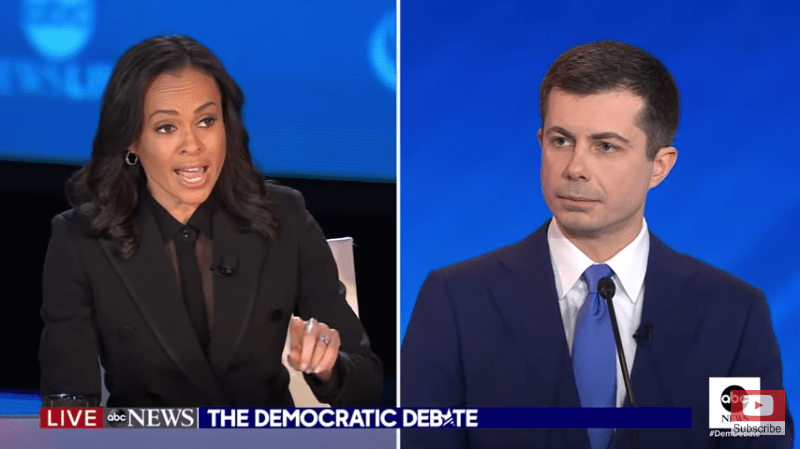
Watch the first 2.5min of this exchange from last night’s Democratic Primary debate.
I was unable to find a good fact check or even good coverage of this exchange – only hot takes and cheers from the far left that “Mayo Pete” finally got his comeuppance. However, the claims made by the moderator were pretty complex, so I dug into the data and did the analysis myself.
First, Davis’s initial, very precisely worded claim that the ratio of black to white arrests for marijuana possession went up during Buttigieg’s mayorship was correct, but a bit misleading. While the ratio of black to white arrests did go up after Buttigieg took office, the number of possession arrests for both white and black people went down significantly during his tenure.
Would it have been better if black arrests had gone down even more than for whites so that the ratio was closer to one? Sure, but did he make things better? Of course he did.
This data tells the story of the real left vs. far-left debate: Would black people in South Bend have been better off if Buttigieg had continued to arrest white people at the pre-2012 rate, making for a more equitable arrest ratio but arresting more people for a victimless crime? If you really understand these data and your answer is “yes”, I would suggest that you are are more interested in vengeance than justice or equality.
That debate aside, I must turn my ire to moderator Lindsey Davis. Like many journalists, she started with an interesting issue but brought more heat than light.
Davis pushed back against Buttigieg’s imprecise answer, and this is where she started making mistakes:
Davis: “How do you explain the increase in black arrests in South Bend under your leadership for marijuana possession?”
This statement is flat out false. For the data we have, the rate of black arrests was significantly lower under Buttigieg and continued to fall for most of his administration. She probably meant the ratio of black to white arrests, but that is a completely different claim.
Buttigieg: “and again, the overall rate was lower than the national rate…”
Davis: “No, there was an increase. The year before you were in office, it was lower, once you became in office in 2012, that number went up. In 2018, the last number year that we have record for, that number was still up”
Check out the data. Again, she’s probably meaning to say that the ratio of black to white arrests went up, which is true. However, what she is clearly saying, that the arrests of black people for possession went up, is wrong. Arrests of black people for possession went down while Buttigieg was mayor.
There was a spike in 2018, but this is clearly an outlier and arrests that year went up for both white and black people and the ratio held steady.
Buttigieg had an imprecise answer about his overall arrest rate, which isn’t quite the point I have been trying to make. Not unreasonably, he wasn’t completely up to speed on the data she was throwing at him. This is the actual “gotcha” journalism that I believe is unfair.
As I watched this exchange live, what I mostly bumped on was their use of rates, ratios, and percentages to describe arrests in a city of only about 100,000 people. That’s too small of a city to describe in such terms as opposed to absolute numbers. You could bust one big college party and see the rate skyrocket. However, I’m sure that this is not an argument that Mayor Pete wants to make: highlighting that his city was so small that you probably can’t learn much about his governance from data like this.
See what happens when journalists get sloppy… Warren jumped on Buttigieg not confronting the facts, the narrative about Pete’s performance gets distorted, we miss an important ideological debate, and already complex nomination process for the potential leader of the free world gets further confused.
METHODS: The demographic data for annual arrests for possession of marijuana in South Bend, IN was downloaded from the FBI, the same data Davis was citing. I tried to get a baseline of how demographics in the city have changed, but couldn’t find a breakdown from year to year. Instead, I combined the data from the 2000 and 2010 census and another survey from 2017 to get a baseline of 60.25±3.60% white and 25.66±0.66% black residents of South Bend, IN. These standard errors were then propagated to give a general sense of the variation in baseline.
It was perfectly reasonable, though disappointing, for pro-life, pro-corporate, anti-tax Republicans to support Trump as their nominee, despite recognizing all of the obvious and disturbing aspects of his character. There was no shortage of rational, non-bigoted Republicans who knowingly voted for a racist, stupid, misogynist who was wildly unfit and unprepared to become the most powerful person in the world, voting merely so that they could get the judges and tax rates that they wanted. It is the inevitable byproduct of the two-party system, choosing between the lesser of two evils. The American left would have probably done the same had the shoe been on the other foot.
Now, Donald Trump is president, and the West Wing is crawling with reactionary Republicans. Neil Gorsuch will reign supreme, and Paul Ryan will have at least two years to pass sweeping, conservative legislation. Nothing will change without action from Congressional Republicans. However, even the most reasonable, responsible congressional Republicans still refuse to push back against Donald Trump with respect to Russia, corruption, and civil rights. The left is correct to accuse GOP leaders of putting party before country. That is a refrainworthamplifying.
However, before the left turns the smug disdain up to 11, let’s test this accusation of ‘party before country’ for validity and hypocrisy…
If, for the sake of argument, all Republicans care about is abortion and tax policy, it’s in their best interest to stand by President Trump. They need the Republican White House to be politically strong for the sake of passing legislation and re-electing a Republican president. That’s what we mean by putting party before country. Single-issue voting may be effective, but it produces an immoral disregard for the complexity of federal policy and the number of issues that are critical to consider when stepping into the ballot box. Don’t be a single issue voter. Don’t do it.
Let’s consider hypocrisy. Would Democrats be willing to put country before party? Fortunately, we weren’t forced to vote for a Trump-of-the-left, but liberals will have the opportunity to show their true colors very soon. If Donald Trump truly represents an existential threat to the country, and if Donald Trump must be defeated for re-election at all costs, who should the Democratic Party nominate for president in 2020?
The Democrats may be able to defeat Donald Trump with a liberal like Bernie Sanders or Elizabeth Warren. They may be able to elect an establishment pick like Tim Kaine or Corey Booker. However, there is risk in that kind of choice. Such a general election will be another polarized slug fest, pitting left v. right over a few million votes, an election that could turn on a dime and risks a full four more years of Donald Trump with his finger on the armageddon button.
The Democratic Party can make a patriotic choice to ensure victory in 2020, but it requires putting their money where there mouth on Donald Trump and putting country before party.
They could nominate a moderate Republican. It’s not a comfortable thought, but it would transcend the ideological divide to produce an election about character, fitness for office, and experience. After all, the presidency isn’t supposed to be ideological.
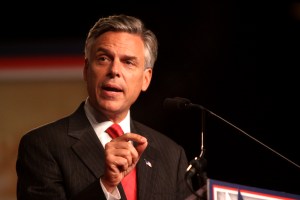
Jon Huntsman, the only guy to look more presidential than Mitt
Jon Huntsman, who has advocated for a third-party since his presidential run in 2012 would be an ideal choice for me in this scenario. John Kasich, who was supposedly every Democrat’s favorite Republican in the 2016 primary, has to be on this list. However, his views about religion make him a nonstarter for me. Bill Weld is a highly qualified, former VP nominee of the 2016 Libertarian ticket and flirted with endorsing Hillary Clinton in 2016. Democrats could have a look at famous swing votesSusan Collins and Lisa Murkowski from the Senate. Jim (Rambo) Webb is practically a Republican who probably voted for Trump. Bob Dold is a youngish, socially liberalish, pro-choiceish Republican Congressman from Illinois who has been trading his job with Democrat Brad Schneider every 2 years. Colin Powell is too old, but perhaps a non-partisan administration official can come forward.
Would this work? Probably not. It would almost certainly elicit a third party left-wing revolt. However, consider that every problem with this scenario also applies to Republicans choosing to defy President Trump. How does the left’s characterization of Trump have any credibility while nominating someone from the left who forces rational, non-bigoted Republicans into the same choice they had to make in 2016?
Before you accuse Republicans of putting party before country, question if you would do the same. Put yourself in their shoes.
I’d hate to say it, but Paul Ryan was right about Planned Parenthood in his recent CNN town hall. Funding PP does ‘effectively’ fund abortions with taxpayer money. All the meticulous accounting that PP is committed to can’t prevent non-abortion revenue (mostly from medicaid) from paying for staff, PR, utilities, and infrastructure. However, Ryan has a tough road ahead of him to clean up the confusion.
Speaking of roads, the federal government funds the transportation that gets people to abortion clinics. Taxpayers fund the abstinence only education which has demonstrably lead to more abortions. Taxpayers fund elections that occasionally elect people who fight to keep abortion legal and accessible. The federal government even pays millions of federal employees, some of which occasionally purchase abortion services! Clearly Ryan has a lot to clear out of the federal budget.
If the sarcasm of this post isn’t obvious, I apologize. I can be very dry.
No one knows how Donald Trump will be remembered decades from now, but what is clear is that he will be remembered. When Donald Trump plans a rally in my backyard at UIC, I have to witness history for myself.
I had friends who only attended the protests outside, but I wanted to see the event and the man himself. More importantly, I wanted to see his supporters and eavesdrop on their conversations. The plan was to stay quiet and blend in, at least until Trump started speaking. I didn’t plan on raising a ruckus, but I hadn’t ruled it out.
Who Goes To These Things?
My wife, Jenn, and I showed up very early, parked, and got in line. On occasion, silent protestors walked past the line holding anti-Trump signs. I did my best to subtly wink at them. It didn’t work as they had learned to avoid eye contact. A few people in line made little, derisive but light-hearted comments at them, but it was a beautiful day, and the Trump supporters we saw weren’t very worked up. They seemed to feel invincible, and thought the protestors were adorable.
Behind us was a group of wealthier, suburban women. Ahead of us was a group of 4-6, very bro-y men in their 30’s or 40’s. Their behavior and comments made me nervous. They hit on a couple of the younger protestors nearby, and laughed very loudly and derisively when they saw a “Bernie 2016” sign. They were trying to take pictures of some of the women who were protesting, and it was just a little creepy. They jeered at a protestor walking by, “Awwwee raciiiismmm, waah waah waah!”
There was plenty of security, and they looked stressed out. Most were apparently outside contractors. Protestors were behind barricades, far on the other side of the street, and we could only hear snippets of things from a megaphone. The entrance was run by police and TSA agents. (Yes, TSA agents. No idea why) There wasn’t much of a police presence in the venue. I had heard stories of screening for Trump supporters, and Jenn and I had our pro-Trump characters at the ready, but there was no such screening. We also got a sign…
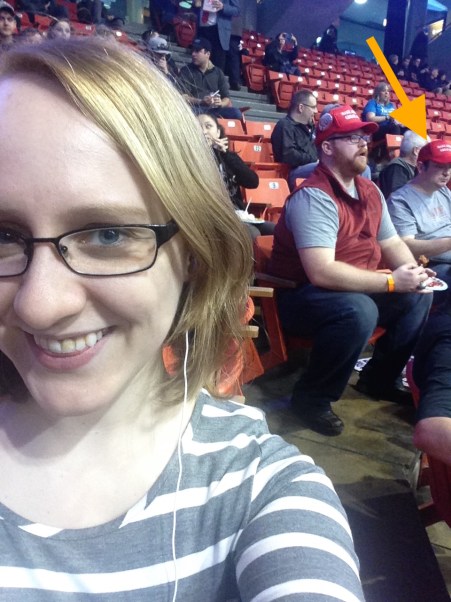
We sat a few rows back from the floor on the lower deck. To our left was a guy who looked like a heavier Ted Cruz. He was wearing a “Make America Great Again” hat and eating wings. That image brought me intense joy. Fortunately, Jenn caught him in a selfie:
Both these guys are just art
The people sitting behind us were the most fabulous characters. There was a guy directly behind me holding court with his friends, and he was exactly what you would expect from an avid Trump supporter. Here were some quotes from him and his friends:
“There’s a bunch of orientals here”
“Look, there’s women here. I thought Trump was sexist? Baahahah!”
“It’s really cool to see a diverse crowd, like all the oriental people”
“There’s more people on welfare in Illinois than have jobs”
“You know, people on welfare get over $40,000 in benefits”
“This is going to be civil war, because shit’s getting out of hand. The plan is for me, my two ex-wives, and two ex-mother’s in laws to come to my house, but if they’re going to live under my roof and eat my food and water, they’re going to learn how to defend it. I’ve got a bunch of guns, because the people I have to protect don’t have guns. I’ve got two AR-14’s, a bunch of shotguns, and 9 handguns. I’m in Naperville, but it’s the city that’ll be hell which is why the police all learn urban warfare…”
“All those protestors should just get a job.”
“I heard a joke that Monica sucks better than Hillary because Hillary doesn’t suck at all. It’s been confirmed that Hillary is into girls anyway.”
“Look at all the orientals!”
There was a hispanic family that made matching shirts. The mom’s said “women for Trump”. The dad’s said “All lives matter”. A couple young women wore “Make Donald Drumpf again” shirts. There were a significant number of more racially diverse people who were clearly there to observe. They weren’t Trump supporters, but they weren’t causing problems. My guess is that it was probably 50/50 between supporters and non-supporters. I saw several women wearing hijabs, and I did not see them harassed.
Trump was supposed to speak at 6pm. At 5:30, the 10,000 seat venue was about 2/3 full, and every 5min or so, a protestor was ushered out to loud chants of “USA! USA!”. I thought that these protestors were foolish not to wait for Trump to arrive to start protesting. Later, a few BLM protestors began chanting in the back, but refused to leave when security came. It was then that I noticed that two whole sections in the back were packed with students. They chanted as one, “LET HIM STAY! LET HIM STAY!” on behalf of the BLM protestor. A few Trump supporters started shouting back, and ~20 police officers filtered in. When a cop confronted a shouty Trump supporter, it was amazing to see the student section’s chant turn on a dime to “KICK HIM OUT! KICK HIM OUT!”. So much for principles. Jenn caught video of these early scenes. The cheering is from Trump supporters.
A voice over the PA made a statement about how to deal with protestors. Paraphrased, he said, “Donald Trump is a strong supporter of freedom of speech, but this is a private event. Some people have abused Mr. Trump’s hospitality and attempted to use his rallies to promote their own agenda. If you notice a protestor nearby, raise your sign high in the air to notify police of the protestor’s location and chant “Trump! Trump! Trump!” until the protestor is removed”
Until about 6:30pm, there were periodic group chants by small bunches of students and distant shouting between Trump supporters and protestors. It took a while for police to kick out everyone they wanted, but it didn’t seem to make a dent in the population of anti-Trump students. All in all, there were several significant, but isolated incidents.
Shit Gets Cray
At ~6:40pm, there was a significant lull in the energy of the room. Trump was very late. Protests had stopped. An unknown man came to the microphone. Here is the announcement, and a bunch of shots of the ensuing chaos.
As soon as he said the word “postponed”, the place. went. nuts. The students erupted. Fists shot into the air from every section. My jaw dropped. People jumped the railing and streamed onto the open floor where people were running around screaming and celebrating.
The reaction of most Trump supporters was to stand in shock, and rather quietly, turn to leave. The invincibility that Trump supporters had previously conveyed was shattered. It looked and felt like pure victory for the protestors and pure defeat for Trump and his supporters. The cheering coming from previously silent people all around the venue was a shock to the Trumpeters. My neighbors looked aghast and stared when Jenn and I, who had previously been silent, started cheering with them.
I had been texting the whole evening with a friend who was protesting outside. According to her, the protestors had advanced on the streets, blocking intersections. When I told her that the event had been cancelled, she was shocked. It became apparent later that this news took a long time to reach the protestors outside.
Inside the venue, the next hour was filled with joy and a sense of witnessing important history. The entire venue was switching between the following chants:
“WE BEAT TRUMP!”, “BERNIE! BERNIE!”, “STOP THE HATE!”, “FEEL THE BERN!”, and “SI, SE PUEDE!”
It was abundantly clear from the crowd, the signs, and the homogeneous chants, that there was perfect overlap with the anti-Trump and pro-Bernie crowd. I can’t stress enough that this was almost as much of a pro-Bernie protest as an anti-Trump one. The pro-Bernie sentiment added an extra bit of joy to the protests. This also was not an isolated celebration. The venue was packed with raucous, anti-Trump people long after the announcement. Here’s a collection of videos that we captured that includes some of the chants, my one encounter with a couple Trump supporters itching for a fight, and a shot of the protestors outside:
Jenn and I wandered over closer to the student section, hanging out at the rail. We could see ~10ft in front of us on the floor, where there were serious confrontations between protestors and Trump supporters, but I saw no actual violence. It was mostly people walking with signs and shouting at the crowd or at each other. Many of the protestors linked arms in long chains so that they couldn’t be kicked out. None of the protestors were leaving, and it didn’t take long for us to be >80% of the crowd.
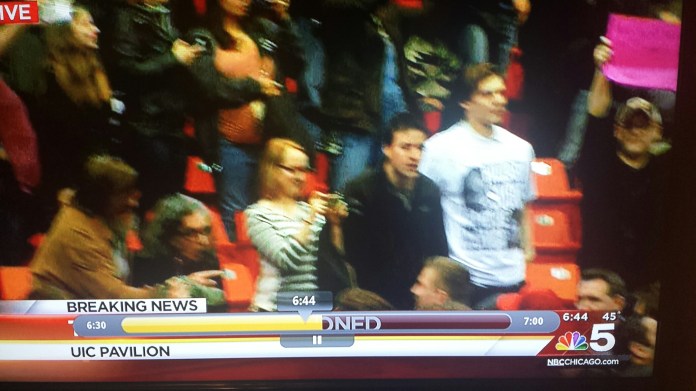
We were even on TV!
The young guy next to me was wearing a white, pro-Trump shirt. He was very mild mannered and asked me if I knew when the rally would be rescheduled. I said that I doubted it would, and he was disappointed. I agreed that I had wanted to hear from Trump. He told me that he hadn’t decided if he would support Hillary or Trump, and you can imagine my surprise. We spoke for a few minutes about Bernie, and he wasn’t interested in a “socialist” or any of my explanations. (Meanwhile, joy and chaos surrounded us) When it came to the violence that Trump advocated, he said, “maybe that’s what we need”. “Violence?”, I said. He agreed. I said, “Then I will be standing opposed to you.” No, it wasn’t witty. I just was simply done with that conversation.
I stood watching and chanting along with the crowd, joyous tears welling in my eyes. When a man came on the PA asking us to disperse, Jenn and I did. I wanted to see the protests outside.
As we left, the crowd was extremely dense, and felt a lot like leaving a ballpark after the home team had beaten a rival. The differences were that no alcohol was involved, tempers were much more intense, and the losers were not really shouting back because the numbers were so against them.
The protest outside was unusual because you had anti-Trump supporters behind barricades, instinctively castigating people that left the venue. (almost all anti-Trump as well) On the street were many mounted police and many more on foot, separating two raucus crowds behind barricades… that, ironically, were protesting the same thing. It turns out to be very difficult to communicate with protestors 30 feet away from you that you agree with them.
We found a few trashed boxes of mass-arrest forms and zip-ties, so I got myself a souvenir…
The parking garage was completely blocked by protestors, so we spent an hour walking around the protest on both sides of the street. They appeared to be almost entirely UIC students. The feeling was of immense joy at the victory, pro-Bernie fervor, and the occasional person arguing with police. I also witnessed a few people thanking officers for what they did. From what I saw, police seemed to handle the situation admirably.
Reflections, what does it all mean…
Sure, it’s momentous. Sure, it’s historic and may be a turning point in this historic election. However, it’s not necessarily a clear, ethical win.
The spin from Trump is that the protestors suppressed his freedom of speech. Maybe. There is certainly a troubling culture of threatening and stifling speech on college campuses. We need to do away with the dogma that college is inherently a “home” or “safe space” where students should be free from disturbing ideas. Students have the right to protest, to speak out, but it is against our values of freedom of expression to shut down or even shout down a guest speaker.
On the other hand, Trump wasn’t really a guest speaker. He wasn’t giving a lecture on a controversial set of ideas. It was explicitly a political rally, a venue for emotion, encouragement, and the voicing of passions. Passions were voiced, but they weren’t the one’s that Trump wanted to win the day. A principled leader would have showed up and dared to confront a hostile crowd with speech, as he was free to do.
On the other hand, it depends on the nature and goals of the protests outside. If the sheer numbers and intensity were what kept Trump away, then he simply, cowardly bowed to pressure. If the protestors were literally blocking access to the venue, or made explicit threats to him if he came, then the protestors have clearly infringed upon his freedom of expression. I hope that’s not the case, and that this isn’t another triumph of the illiberal left to stifle speech.
This is a win for Bernie Sanders. This is what a political revolution looks like. It starts with young people, at colleges like UIC, standing up for what they believe in. Protests can work, and they can drive change. It’s up to the rest of us to decide if we keep it moving.
Oh yea, VOTE! ELECTION DAY in ILLINOIS is TUESDAY, MARCH 15! VOTE early, VOTE often! FUCKING VOTE!!!
I’ll never forget this moment. I was 17, and watched the speech on our basement TV because my dad was gone at a conference, and my sister was watching some other TV show upstairs. I was pretty psyched that someone from Illinois was giving the keynote, sitting on the floor because there was no couch in my dad’s basement office. I hadn’t followed the 2004 IL senate primary very closely until now, so this was the first I would hear from Barack Obama.
The 2004 primary had been pretty lame. An insurgent Howard Dean campaign excited the liberal base, but showed itself to be too immature to go the distance. After last nominating the soporific Al Gore four years prior, the party stayed sedate with John Kerry, a taller, war-hero version of Michael Dukakis, but ultimately no more politically talented. Democrats seemed to think that the old formula would work ok with just a few tweaks and a few more checked boxes.
In 2004, punditry and cable news were the dominant force and the internet was a fringe novelty. We were several years from facebook and smartphones. Media was becoming more partisan. The country was engaged in two of the longest wars of its history, incompetently waged under false pretenses. Eight years of Bush were marked, above all, by incompetency. Obama didn’t have a magic message that solved those problems; he simply refocussed our attention on the real point. The parallels to the Gettysburg Address are obvious to me, but probably too heretical to detail without greater historical distance. We have a habit of underestimating the relative importance of recent history while overselling the potential significance of our next achievement, but I digress…
Obama spoke about the reality of American life that had nothing to do with party identity. As he belittled the color-coding of states, punditry, and tired wedge issues without a trace of the smugness or elitism that hampered old liberals, my mouth dropped farther and farther at how perfectly he captured the political moment. In a desperate atmosphere, he showed us the triumph of what we already had. After that speech, I was convinced that he could be our next president. I rushed upstairs and told my mom, and she smirked at me. “That’s not how it works”, she told me. I might as well have said that Jon Stewart would be the next president.
Twelve years later, I believe we are setup for another such moment, perhaps even greater. Given the current partisan divide, someone who can articulate a bigger picture and a new national ambition could cut through. We are forced by events to be narrowly focused on process, on overcoming routine budget disasters threatened by an increasingly radical and obstructionist right wing. We live in a world where nativist bigot Donald Trump and “socialist” Bernie Sanders are serious contenders for their respective nominations, and there is significant overlap in their electorates. “Conventional wisdom” has become a joke about what probably won’t happen. We are gripped by fear of foreign violence with no rational basis, as if ISIS had the Soviet Union’s nuclear arsenal at its disposal. We are steeped in potential for a new leap forward in leadership. The key to the perfect voice for this political moment is not one we can predict, but we know it when we hear it.
That summer in 2004, I started as an intern at my local Democratic headquarters. I worked 30-40hrs per week organizing and campaigning for candidates I wasn’t old enough to vote for. George W. Bush taught me the consequences of politics, but I think it was Barack Obama who changed politics from a sport that I had long followed into a sport that I could play.
When political reporters and bloggers talk about a pending election, we can usually expect little more than a recitation of the latest poll. The great ones might throw in a margin of error.
Since 2008, Nate Silver brought a whole new brand of analysis using reason and actual statistical analysis. He didn’t make predictions; he calculated probabilities. In 2012, while many pundits were wildly wrong, Nate accurately predicted the outcome of all but one election, suggesting that his probability forecasts might have even been too conservative.
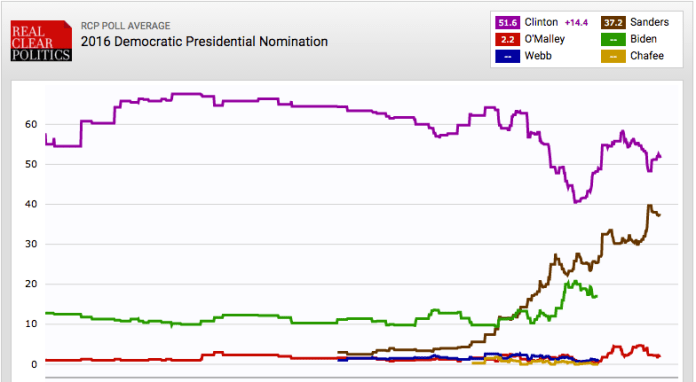
I’ve been disappointed by FiveThirtyEight’s 2016 coverage and change in vision for a number of reasons, but I’ll focus on one here. Many of their posts have argued that Bernie Sanders has a big (yoooge) demographic advantage in Iowa and New Hampshire, since those two states have some of the highest percentages of self-described “white liberals”. Though consistently trending up, Bernie Sanders is still trailing Hillary Clinton nationally and in states following Iowa and New Hampshire. FiveThirtyEight argues that demographics are to blame. They bring it up again, and again, and again, and again, and again, and again, and again, and again, and again… ok, you get the point. FiveThirtyEight can’t get enough of the “white liberals” argument. Here are 2016 polling aggregates from RCP in Iowa, New Hampshire, and nationally:
Iowa, 2016
New Hampshire, 2016
National, 2016
The problem is that Bernie’s higher poll numbers in Iowa and New Hampshire could be due to demographics, or more likely, are simply due to Iowa and New Hampshire being first, more engaged, and therefore most likely to show interest in a truly insurgent campaign. The rest of the country is obviously going to be slower to take notice. Obama wasn’t nearly the insurgent that Sanders is, nor was he even anti-establishment, yet you saw a similar trend in their numbers in the early states. Keep in mind that in 2008, the Iowa Caucus was on January 3.
Iowa, 2008
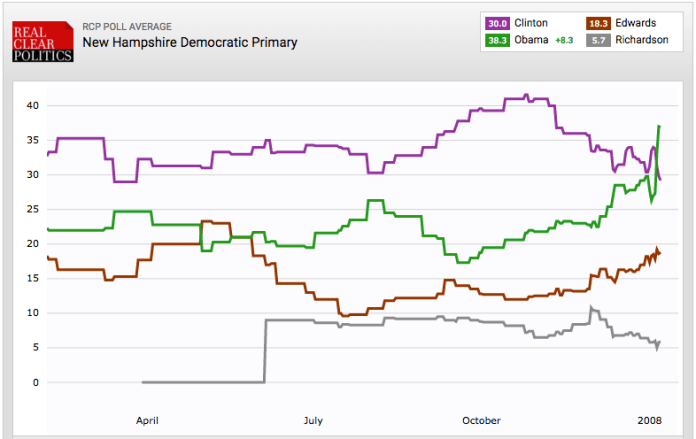
New Hampshire, 2008
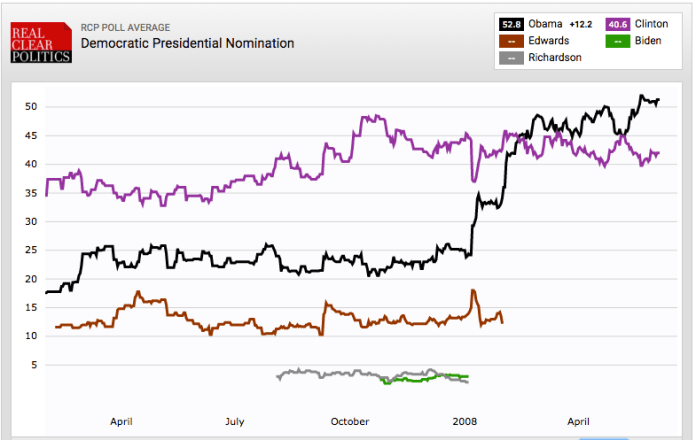
National, 2008
Clinton led Obama by 20 points until Iowa and New Hampshire. He continued to trail her by 10 points nationally all the way until Super Tuesday, after which he edged out a narrow lead. Sanders is actually doing much better nationally than Barrack Obama did at this point in the race.
I think that it’s simply a matter of time rather than race and labels. The results in Iowa and New Hampshire move national opinion, which is why the candidates put so much time and effort into them. Later states are going to be naturally delayed in paying attention, and naturally hesitant to support an insurgent.
The “white liberals” argument really comes from the demographics of South Carolina where there is a significantly larger black vote, especially among democratic primary voters. Sanders has long trailed Clinton in South Carolina, especially among African Americans. It’s important to realize that very little polling has been done so far in South Carolina, including only two this month. Let’s look at the latest CBS poll in South Carolina, since it asks some interesting questions beyond your typical tracking poll.
Clinton is ahead of Sanders 60/38. Clinton leads Sanders 76/22 among African Americans and Sanders is winning among Whites 60/38.
In my opinion, the most important question from this poll was “How much attention have you paid to the 2016 election so far?”. 46% of likely Democratic voters have paid “some” or “not much” attention to the campaign, so there are plenty of minds to be changed, and that will definitely help Bernie. More important is who those open-minded people are. They are disproportionately young and African American. It’s well known that Bernie is huge (Yooooogge) among young people, and it explains the tepid support from African Americans. Those who haven’t paid attention to this campaign are much more likely to support the well-known, establishment candidate… at least for now.
Conclusion? There is none. That’s why FiveThirtyEight should stop acting like they’ve found the secret decoder ring that will keep Bernie Sanders from the nomination. Maybe African Americans will reject the candidate who marched with MLK, got arrested for protesting segregation, fights for $15/hr minimum wage in favor of the pro-death penalty candidate who pushed the crime bill, mandatory minimums, TPP, and the Iraq war. Maybe… but extraordinary claims require extraordinary evidence.
Half of the country is unwilling to challenge the virtue of weapons that are obsolete in a modern world but pervasive in our culture. These close-minded, obstinate Americans see the costs and routine massacres of human life but won’t even acknowledge the central role these weapons play in the carnage.
For the right, it’s guns. For the left, it’s religion.
I am pro American leadership. I am anti-war. What we must do is remember what it means to be American: pro-freedom, and the land of opportunity, of immigrants.
Here are my policy proposals:
Declare American opposition to ideologies that conflict with basic human rights. Recognize that Christianity was once, and in a few ways still is, such an ideology. Challenge the world’s muslims to reform and modernize their religion.
Pour American money into the housing of Syrian refugees in neighboring countries, and commit the US military to oversee and protect their transfer and any temporary camps.
Remove or drastically raise caps on the acceptance of refugees on US soil.
Accept a non-zero, low level of terrorism, even on US soil, as the cost of a free country.
We are neglecting a war of ideas in favor of a war of vengeance. Waging a war of ideas means that the President of the United States and the free people of the west say without equivocation that we are for freedom of expression everywhere. We are for freedom to worship everywhere. Therefore, we must oppose any ideology, including any religion, that infringes on the rights of others. We must stand against radical Islam and any violent ideology that is so fundamentally opposed to peace and modernity.
The left needs to have a few ideas pounded into its head: Islam is not a race. Criticism of an ideology, even war against an ideology, is not bigotry or prejudice any more than wars on fascism, racism, or communism. Of course there are anti-Arab, anti-muslim bigots, and of course there is no legitimacy in that prejudice.
Imagine if, during World War II, when we were were disgracefully locking up Japanese Americans for their race, the American left was unwilling to declare war on Japan because, clearly, it’s just racist fervor: “Japan is a nation of peace. Not all Japanese people attacked Pearl Harbor, and the attack has nothing to do with what the emperor of Japan says.”
Containment is an honorable mission. The United States can easily prevent the Islamic State from building a conventional military stronghold. With little risk and relatively low cost, our military can flatten any base or building, forcing our enemies to act small and live underground. Sending billion dollar warplanes to take out snipers and pickup trucks is not a good use of military might. Pursuing Islamists into the shadows, aiming for absolute destruction, is not practical. We have limited resources that could and should be committed to protecting civilians and housing refugees. Americans must welcome the tired, poor, huddled masses yearning to breathe free. The wretched refuse of our teeming shore are forsaken so that we can spend millions trying to blow up pickup trucks in Syria. We should be accepting hundreds of thousands of these huddled masses and pouring money into neighboring countries to support and protect refugees.
Conservatives like to bloviate about liberals “throwing money at the problem”. When it comes to foreign policy, money is one of our most useful tools. It’s time for the American right to stop getting away with throwing bullets and bombs at the problem.
Finally, we must accept that occasional terrorist attacks, even on US soil, are the inevitable result of apocalyptic ideologies. The goal is not to prevent every attack, but to minimize their number and casualties without sacrificing our values or liberty. The gut response to attacks should not be to raise security in the name of “never again”. Rather, our reaction should be that we will never surrender who we are out of fear.
Terrorists love to say that the jihadist loves death more than the infidel loves life. Our challenge is to love freedom more than the jihadist loves death.
The latest in my series of highly biased, non-peer reviewed, low-impact, original research…
I have been consistently frustrated with the mainstream media’s surprise at Hillary Clinton’s falling polls and the success of Bernie Sanders. What’s more frustrating is the common consensus that this is a result of GOP attacks with respect to her emails and the attack on the Benghazi consulate. When pundits discuss her poor perception of trust and likeability, phony comedy routines or anecdotes about Clinton’s mother are suggested as good strategy. For me, all this babble misses the mark by a wide margin. I think it’s a simple matter of answering straightforward questions.
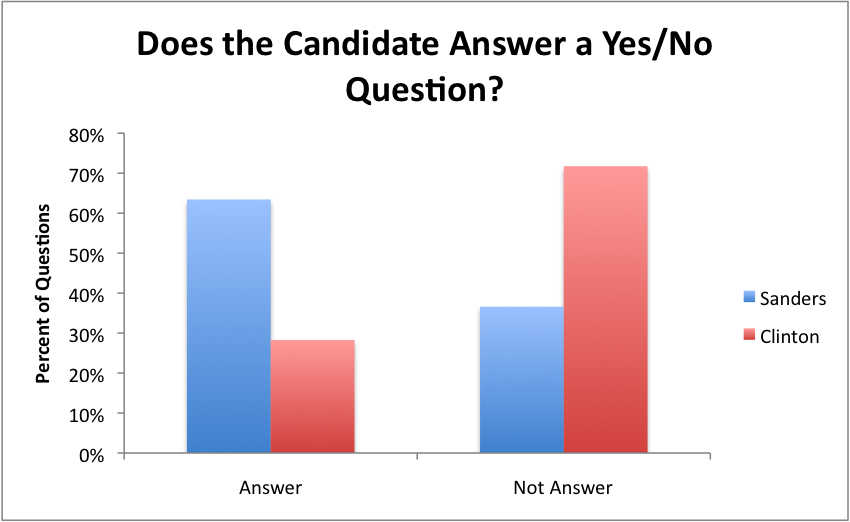
I wanted to study how eager candidates have been to answer an interview question. By quickly and directly answering questions, the audience perceives that the candidate is comfortable being asked anything and has nothing to hide. By focusing on the direct question, the candidate surrenders the choice of topic to the journalist, the representative of the people. I believe that the perceptions of candor and honesty can be more precisely analyzed and even corrected when quantified in this way.
The problem is that objectively determining whether or not a candidate has answered a question is problematic. Who gets to decide that someone did or did not answer the question? How do we distinguish style from substance? Often, questions must be challenged on their premise, and doing so is routine, smart politics as well as logic.
On the other hand, “yes or no” questions are much more simple. Objectively, their answers can only be categorized as “yes”, “no”, or “didn’t answer”. The answer is, by definition, not reliant on an accurate premise. What follows is my analysis of Bernie Sanders and Hillary Clinton’s approach to yes or no questions in an interview setting.
If my impression is correct that Bernie Sanders demonstrates greater candor and honesty than Hillary Clinton by directly answering questions, it should be clear that he answers a greater percentage of yes/no questions than Clinton, and takes less time to do so. Maybe I’m wrong. If this is a misperception of Clinton, merely having to do with her gender, political history, etc, the data should show that she answers questions at reasonably the same rate as Bernie.
Methods:
I collected the top 5 interviews on YouTube from the search “Bernie Sanders Interview” and “Hillary Clinton Interview” respectively. Fortunately, these interviews were comparable in length, content, and both searches even included two interviews from the same journalists, Andrea Mitchell and John Dickerson.
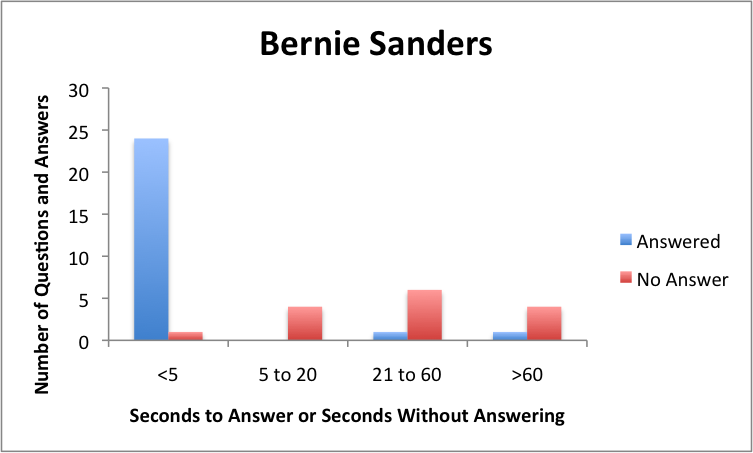
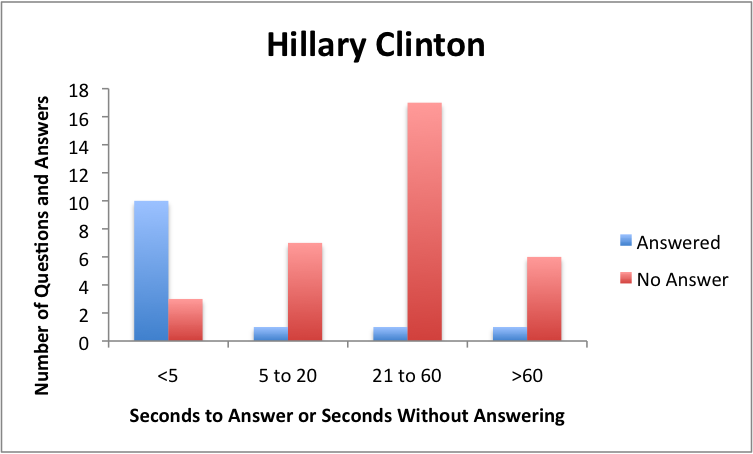
I analyzed only the “yes or no” questions from the interviewers and categorized the candidate’s respective answer into “answered yes/no” or “didn’t answer”. I also recorded the number of seconds it took to get to an answer, (in the first case) or the number of seconds spent talking without giving an answer. (in the second case) I did not record the amount of time talking after giving an answer. This was because, in an interview format, yes/no questions are meant to be open-ended opportunities for elaboration. Otherwise, it would be a very short interview. I don’t think that an explanation of a yes/no answer after the fact detracts from the candidate’s candor, but long explanations before giving an answer do so detract.
For the most part, a “yes” or “no” is required to constitute an answer, but in a few clear cases, answers such as “I agree with that” or “I wouldn’t do that” constituted a clear and direct answer to the question. I watched the interviews on a single pass, and I determined whether or not a question was a yes or no question before analyzing the answer.
I initially included a third category, which was “refused to answer”, because I consider this a non-answer, but still directly addressing the question. However, it only occurred twice with each candidate, and did not require much time to do so. Often this refusal to answer was implicit rather than explicit, so difficult to categorize. I included all these answers in the “non-answer” category for the sake of simplicity.
The clock starts when the candidate starts speaking and ends when the candidate begins the yes/no answer. It was common for an answer to be given before the interviewer was done with the question, in which case, zero seconds is recorded.
The raw data is at the bottom of this page, including a synopsis of the question being asked. The interviews as well as their respective questions are in chronological order so you can look for evolution in the candidate’s style. I encourage you too look it over if you are interested.
Results and Discussion:
I had no idea that the data would be so clear. Bernie Sanders appears consistently desperate to answer the interviewer’s question. Hillary Clinton appears allergic to a straight answer.
In a more holistic, subjective analysis of the questions’ content, I tried to categorize the non-answers into types of question, but found it very difficult to parse. However, there were obvious trends in the types of questions that were not answered. The questions that Bernie Sanders did not answer were almost entirely composed of questions about political speculation or attempts to get him to attack Hillary Clinton. There were only 1-2 questions about policy about which Sanders did not give a straight answer.
For Clinton, on the other hand, about half of her non-answers were about policy. About 40% of the non-answers were concerning her negative perception or controversy concerning her email or the Clinton Foundation. Sanders wasn’t asked as many questions about comparable controversies concerning him, but he answered all of them. The idea that Clinton’s non-answers were merely a result of the controversy surrounding her political standing are not supported by these data.
Above are histograms describing the time required to get to an answer or non-answer. I was surprised to see that the time taken for non-answers was roughly the same for both candidates. Of course, Sanders did not give that many non-answers to analyze. Watching the interviews, I had the perception that Clinton was droning on for a long time without answering, suggesting that the mere quantity of time spent without answering gives this impression. When a candidate answers the question and then elaborates, I think the audience is more relaxed and listening to the explanation. When the candidate goes on and on without answering, there is a tension around whether or not the candidate will come around to the answer we all want to hear. Perhaps this is just me.
When it comes to answers, both candidates tended to give their answer right away before elaborating. Clinton gave long explanations before answering with slightly greater frequency then Sanders, but it was still rare. This is accentuated by the fact that Sanders often answered the question before the interviewer was finished asking the question.
Without clear trends in question content driving the candidate’s candor discrepancy, it appears that Clinton simply doesn’t feel the need to answer direct questions to the degree that Sanders does. I believe that this is a product of old school politics of the 1990’s. When media became fast paced 20 years ago, campaigns became concerned with winning the news cycle and producing sound bites. Staying on message meant answering the questions you wanted to answer the way you wanted to answer them.
Now that online media and social networks have dominated our communication, campaigns aren’t limited to sound bites. Free media is unlimited. Furthermore, people used to the constant exposure of social media expect their candidates to be more exposed than ever. The standards by which we judge exposure and candor have shifted, especially among Millennials. Perhaps that accounts for the large age discrepancy in the polls. We are not as likely to forgive candidates like Clinton who feed us bullshit answers. Unfortunately, we have not yet developed the vocabulary to describe this evolution. Hopefully this research can shed a bit more precision on a previously described intuition concerning political perceptions.
Using prior election narratives as predictions of the current election season should make you roll your eyes. They are fun ideas to play with, comparing Bernie Sanders to Dean and McGovern, but not very informative. Even comparing 2007 Clinton to 2015 Clinton is greatly misleading, so don’t mistake the following data for that. I do think that it is useful to look back at this time in the last, open presidential primary as a measure of the overall presidential campaign season. It is also valuable to remember how different the environment was as a reminder to avoid such juxtapositions.
So, take a ride with me back to 2007, when George W. Bush was president, and Barack Obama had a babyface. The economy had yet to fall to pieces, and no one outside Alaska had yet ever heard of Sarah Palin. Gay marriage was opposed by most major Democratic candidates and only legal in Massachusetts. It was way, way back when we were 4 years into a war in Iraq and Afghanistan…
National Polls
Barack Obama announced his candidacy for president on February 10, 3 months earlier in the calendar than Bernie Sanders would do. I was there on that freezing, seriously fucking freezing day that Obama announced his run. Obama had faced speculation about a run since his kick-ass DNC speech in 2004, so his name recognition was pretty high going in. It’s interesting to see that he hovered around the low 20%’s for so long into the campaign. He entered the 30%’s after winning the Iowa Caucus, but didn’t catch up to Hillary until Super Tuesday, halfway through the actual voting.
2008 National Polls, RCP
With Sanders’ late announcement and the wide gulf in name recognition, the current national polling is to be expected, no matter what the eventual fate of the Bernie Sanders campaign will be. Though he is ~10 points behind where Obama was at this time, Sanders has actually made greater gains since announcing than Obama did. There’s a lot of time left until people actually vote; It’s still very early.
2015 National Polls, RCP
Iowa Polls
At this time in 2007, Obama had been consistently in 3rd place behind Edwards and Clinton, though they were all close enough for it to be anyone’s game. The first debate was April 26, but the polls in Iowa didn’t really start to move until the fall and winter. It’s surprising to me how many debates passed before the field evolved toward what would be a decisive win for Obama and a disappointing 3rd place for Clinton: 38% Obama, 30% Edwards, 29% Clinton
2008 Iowa Polls, RCP
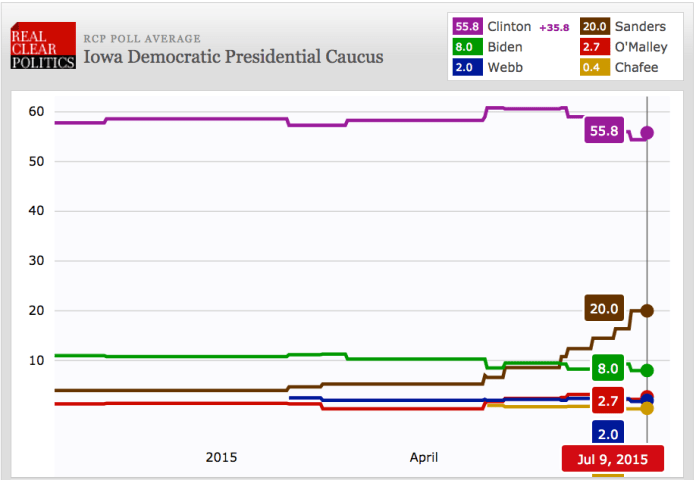
Considering that Bernie’s name recognition was nil going in, and with only one front-runner in competition, there was no place to go but up for him. What is compelling in all of these 2016 polls is that Biden and O’Malley have not made any gains. This is a legit, pro-Sanders momentum that is showing a true 2-person race. However, it is worth repeating this with every analysis of the 2016 polls: It’s way too early to be sure.
2015 Iowa Polls, RCP
New Hampshire Polls
New Hampshire was by far the most interesting story in the 2008 primary campaign. The polls proved to be wildly inaccurate, as an Obama lead and even momentum out of Iowa turned into a loss to Clinton in the Granite State, foreshadowing a long slog of a primary. Edwards support began draining to the two frontrunners, and his hope for a resurgence in South Carolina would not come.
As for the polls, at this point in the year, Edwards was slowly losing support, and wouldn’t really recover. During the fall, Obama’s support was actually falling in NH, despite gains in Iowa. A late surge in NH had many convinced he was in for a big win. Of course, we were reminded that we have to let people vote, and that New Hampshire voters don’t give a fuck about what anyone outside the state thinks.
Though New Hampshire revitalized Clinton’s campaign, New Hampshire polls are the ones that most have Bernie’s supporters doing happy dances. Bernie has gained 15 points in a couple weeks, which is corresponding to a drop in Clinton’s support. It’s easy to imagine Bernie even passing her in this state before the first debate. But again, it’s too early to tell.
2015 New Hampshire Polls, RCP
So What?
FiveThirtyEight did a great piece on Iowa and New Hampshire’s demographics misleading us in their affinity for Bernie Sanders. Read it. It emphasizes the need for Sanders to campaign and show progress beyond the early states, so take these results with that in mind. Unfortunately, there is hardly any polling in the Carolinas, where I really want to see how Sanders performs. I believe that once Sanders is in the debates and gets to tell stories of his role in the Civil Rights movement, his support will broaden a great deal. We also need to hear more of his personal narrative for him to be for real. If anything is clear it is that we’ve only just gotten started. Despite the compelling story of the Sanders Surge of Berniementum, the GOP primary is still the circus to watch. I mean, fucking Trump can be called one of the frontrunners. I’m popping the popcorn already.











 benzalisko.com